Today, we introduce mBER-2, our latest AI protein design platform, updated to match the scale of our in vivo measurement capability.
- Read the technical report
AI has made remarkable progress in designing proteins that bind a target. But a binder is not a drug: turning binders into medicines requires discovering which targets, binding sites, and molecular properties produce useful behavior in the body. Much of this in vivo biology remains unexplored because testing molecules in living systems has traditionally been slow and expensive.
At Manifold, we are making in vivo exploration scalable. We have invented a suite of molecular barcoding technologies that allow us to measure the tissue distribution of more than 500,000+ binders in a single experiment in living animals (in vivo). We can investigate thousands of design possibilities in parallel, searching for new routes to deliver medicines to tissues and cells.
Each binder is both a potential component of a medicine and a probe that helps us interrogate biology. Our experiments are revealing solutions to grand challenges in tissue-targeted medicines while generating data that connects molecular design to function in living systems. We are using those measurements to build the Virtual Organism, a model that can predict the in vivo behaviour of a molecule from sequence alone. We are building it in layers, starting with Virtual Organism 1.0, which predicts targeting and distribution.
mBER-2 is the next generation of our mBER-open design model, which we released last fall [link]. mBER-2 follows a similar generative approach to mBER-open, but with substantial optimizations intended to improve inference speed and efficiency, epitope-targeting capabilities, binder properties, and overall hit rates. It expands the targets, binding sites, and molecular formats we can explore, giving us the diverse molecules needed to systematically test how these parameters affect behavior in the body.
Scale: Enabling designing across thousands of targets
We have optimized mBER for extreme efficiency in scaled design. In a recent run, we scaled inference to over 4,500 GPUs in parallel, designing over 50 million binders against 1000 targets. This breadth lets us comprehensively investigate all potential routes for delivering medicines. Paired with the ability to test all designs directly in living systems, we’re able to discover useful biology, and the molecules that exploit it, that a typical one-at-a-time search could miss.
Coverage: Producing binders to 98% of tested targets
In experimental validation, mBER-2 produced binders to 55 of 56 tested therapeutically relevant targets, including several with no previously reported designed binders, with target hit rates averaging 16.8% for high-confidence VHH designs. That breadth gives us confidence to pursue targets that are historically challenging, such as GPCRs. When conventional binding assays aren’t feasible for a given target (e.g. when reagents are not readily available), in vivo experiments become the way forward: testing molecules directly in living systems to discover what they actually do in the body.
Diversity: Exploring where and how to bind
Binding the right target is only part of the challenge. Where a molecule binds, and how tightly, can dramatically change its behavior in the body. Strong binding can help a molecule accumulate at its target, but can also trap it before it penetrates deeper into tissue. The best affinity depends on what we want the molecule to do.
mBER-2 designs binders to more than 20 distinct sites on a single target and lets us tune binding strength. Testing these combinations in vivo lets us search for the site and affinity that produce useful delivery, connecting the details of a molecular interaction to its effects in the body.
Microbinders: Expanding the formats we can design
Size and shape change where a molecule goes in the body and which binding sites it can reach. Microbinders—small, structured peptides roughly 10-45 amino acids long—expand the formats we can explore for delivery. Their short sequences also offer a route to chemical synthesis.
At this size, a molecule must do two jobs: hold its shape and bind its target. mBER-2 starts with compact scaffolds whose structures are known, preserving the features that hold them together while redesigning their exposed surfaces for binding. We have experimentally validated binders in more than 31 microbinder formats, most of which have never been leveraged in de novo design. In our screens, some produced binding hits where larger formats aimed at the same sites did not.
In Vivo: From Binders to Drugs
If a 24-well screen can identify working binders to a single target, why design millions?
Most of the target biology that could be useful for medicines remains unexplored. Thousands of receptors of interest have never been produced in vitro or bound by a drug. These receptors may hold the key to curing important diseases. mBER-2 complements our ability to screen in vivo at massive scale and allows us to explore that biology in living systems: discovering which targets, and which ways of binding them, produce useful behavior in the body.
We are using mBER-2 to design and refine millions of binders to sites across the human proteome, an effort we refer to as the EpiTome. We are well on our way to screening the entire EpiTome library in vivo, generating a proteome-scale dataset that links designed sequence to structure to binding to measured behaviour in a living system.
Design and in vivo experimentation have progressed at a pace we once thought impossible. To date, we have generated over 50 million binder designs across more than 8700 distinct target proteins. We have tested over 3 million binders in animals, including over 1 million in non-human primates (NHPs), measuring their biodistribution and clearance with our proprietary molecular barcoding technology.
Our screens have identified designed binders that accumulate preferentially in almost every tissue measured. Crucially, our campaigns have produced binders against several receptors that remain unreported in the public literature and lack known functional characterization.
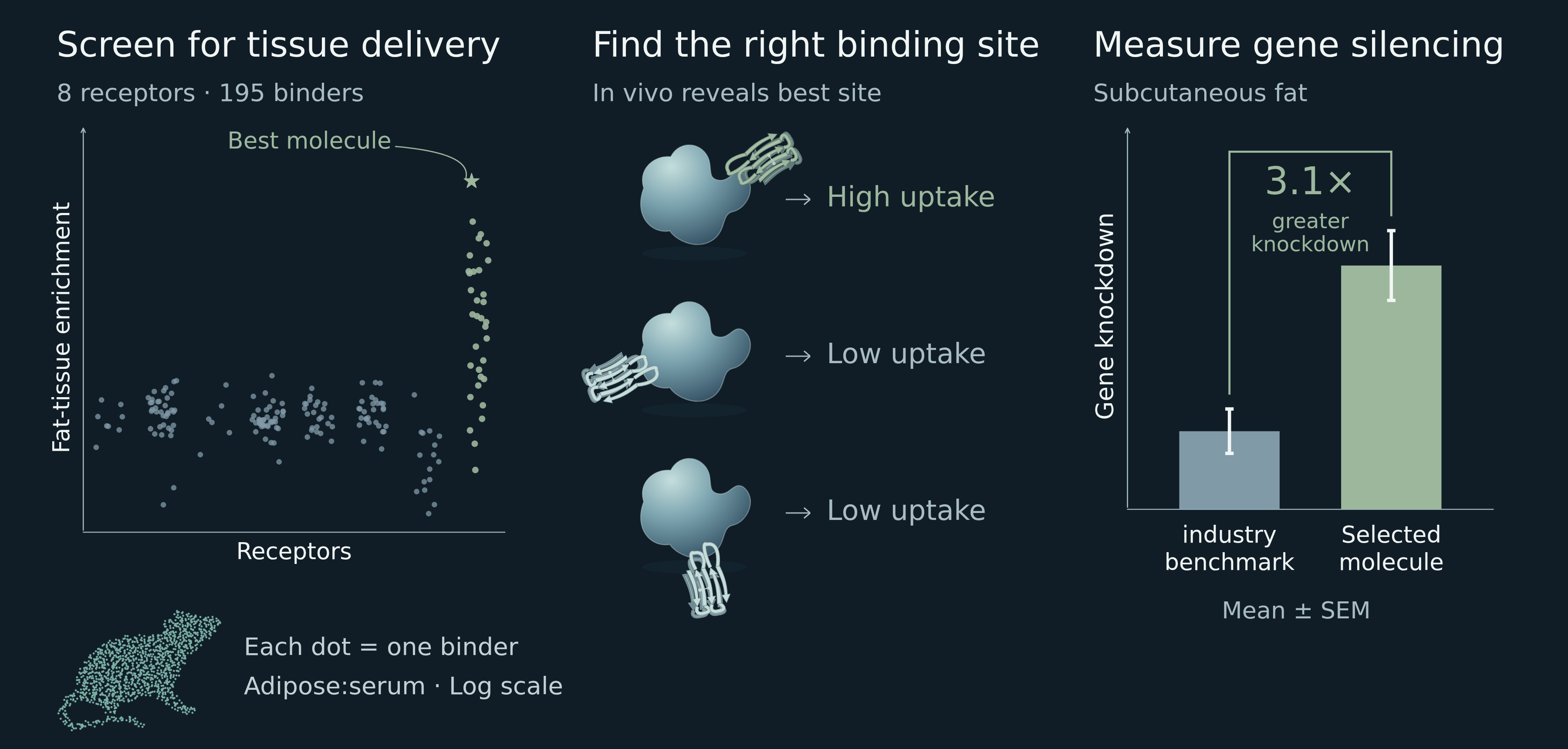
In one case, we discovered a novel receptor that enables strong, selective delivery to adipose tissue. Our models show that where and how we bind this receptor are critical to producing that function. Measuring those differences in vivo helped us identify the molecules with the delivery behavior we needed. These molecules are now advancing toward human patients.
An Interface Between AI Drug Design and Living System Biology
We have now established the ability to design and test millions of candidate proteins in vivo. The result is data to build world models of biology previously out of reach.
We are already using these data to build the first layer of the Virtual Organism: a model for predicting how molecular properties and target interactions shape distribution and transport in the body. Our goal is to use those predictions to guide experiments and design targeted medicines.
Our ambition is to expand beyond designing where drug candidates go. We are already working on new technologies for measuring what molecules do when they arrive at their destination. By generating a massive amount of data on molecular function in vivo, we are positioned to build the ultimate model that designs medicines others cannot.
See the technical report for full results.